|
|
|||||||||||||||||||||||||||||||||||||||||||||||




|
Mutual esteem, respect and consideration resolve these things, or should the conflict of two rights mean war? |
|
A paraphrase from the story RESPECT AND AWE, motto of the collection THE PATTERN AND KANT |
BIO-BIBLIOGRAPHICAL NOTE
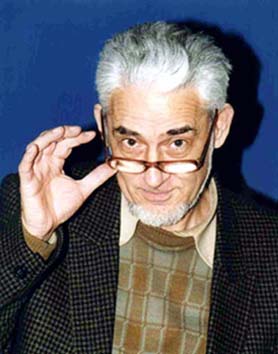
Born in Belgrade, Yugoslavia in 1939, where he still lives, he graduated as an electrical engineer and was employed for some time on the regulation of d.c. motor speed on machine tools. He has published professional articles in Automatika magazine but now works primarily as a private teacher of mathematics. He writes in his native language, Serbo-Croatian, but also speaks German and reads English. Among his previous works are the following:
|
1974, |
A novel about how and why a young and talented engineer goes to work abroad. Economic and moral disharmony, perhaps as a reflection of the ruling ideology, are unseeing but inevitable reality in the heart and thinking of a young man, torn between two alternatives: to understand and leave or to believe and put up with it. The big publishing houses did not want to take the political risk of publishing this book. It was accepted by Obelisk, which subsequently went (politically) bankrupt and the book was eventually published at the author's expense. The Serbian Ministry of Culture purchased part of the first edition and paid the author a fee. In this way, the book found its way into libraries throughout Serbia but without a single review appearing in the press.
|
1976, |
On Relativity and Symmetry Regarding the Death of Grandpa John
Actually a philosophical novel, this is a literary introduction to a philosophy which indeed adopts all the axioms of the official dialectic materialism of the time, but only as mere descriptions. Based on contemporary exact sciences, it attempts a deeper contemplation of reality. Thus it may be considered a kind of encyclopedic anthology of extracts from physics, chemistry, molecular biology and evolution. It also proposes a new interpretation of Einstein's postulate of the constant velocity of light with reference to the quantum field theory. The essay did not suit the publishers' programs, so was published by the author himself. As the authorities refused to exempt it from sales tax, book stores would not take it for sale. However, it was not banned.
|
1982, |
A social novel to a certain extent, it however deals with actual cultural and political incidents concerning Gajo Petrović, Tode Čolak and so on. These serve as an alibi for reflections on Yugoslav society and on society in general, with an occasional excursion into philosophy. The final chapter lays the foundations for a future political economics of socialism, pointing out the basic socio-economic relationship of such a society and its inherent contradiction: personal or group ownership over the right to political decision. The manuscript was not accepted. The archives of the Serbian Academy of Science and Arts in Belgrade took one copy for preservation.
|
1984, |
Introduction to the Thought of Contradictory Whole
An introduction to the idea of a contradictory whole. Although presented in literary style, this is actually a philosophic work in the ontological sense: regardless of dogmatic or ideological division into materialism and idealism, and the beliefs they engender, it considers the main question of philosophy to be the existence of the world, the answer to which is to be found within itself. The attempt to answer this question opens up possibilities of a new debate with a widely varied range of philosophers: Berkeley and Spinoza, Kant, Hegel and Kierkegaard, which renders meaningless the philosophical foundation of any ideology which seeks to exclude other ideas. This philosophy of existence was not accepted either. A copy was taken by the library of the then Yugoslav Academy of Science and Arts in Zagreb.
When political circumstances finally permitted (1991), the above works were published in one four-volume book under the title:
THROUGH SOCIALISM TO GOD
The title is symbolic of how we suffered under socialism and how each pursued his or her own hopes and beliefs, backwards through socialism to the older values and to parliamentarian government.
1992,
This is not a new book either, but consists of eleven fragments from all four books, selected by the author and presented as a collection of tales in five parts, each with its own heading:
Part I — How it began
Part II —The quandaries we were in
Part III ― Where we looked for faith and hope
Part IV ― Kinds of religious and ideological interdiction
and
Part V — After dreadful destruction, only love can begin from nothing, just as God, it is said, created the world out of nothing. And then there will be room for everyone, for every creed and every philosophy
|
1993, FIFTY YEARS TO WAR |
Five Stories of Socialism from a Personal Point of View
It is self-evident that historical and political circumstances influence the fortunes of men and of entire families. But the far-reaching and unfathomable influence of ideology and its latent violence on the psyche
— and the irrational paths of love or hatred it may take — can only be understood by someone who has had the good fortune to ultimately arrive at a sufficient understanding of his own MOTHER and father, and with them of any ideology, and thereby of the world.It is not always easy to separate economic difficulties from political circumstances. One case of economic emigration is described in the novel FIRST DAYS. Ideological pressure on the economy may cause various forms of internal emigration, the ultimate motive for which may actually be TAX.
Does one social system create a special psychological type of people, or is it the other way about: are the authoritarian traits in man's very nature the reason why authoritarian and totalitarian regimes constantly appear in various places throughout the world? THE MYSTERIOUS MILO may reveal some of the secrets of this correlation.
There can be no doubt that discovering the meaning of the world is necessary to man as an individual. This is the reason for the appearance of the great Utopian ideas throughout history: Plato, Christ, Moore, Owen, Saint-Simon, Marx and Engels. If, however, an institution or armed force stands behind such an idea, its meaning will necessarily become inverted. The story THE CONTRACT shows what wonders may then occur: an apartment costing one hundred thousand German marks, for example, may ultimately be bought for a couple of hundred (not a hundred thousand, just a hundred), albeit under certain conditions. What are they?
If you met a man on the street of any town in the world and asked him, if this or that is a law, regulation or just a government recommendation — perhaps only a political slogan — he will in all likelihood simply shrug his shoulders. How this may be abused in a political monopoly is illustrated by the story THE FIRST IS SECOND, using the example of the foreign language taught in schools. An absurdity wrapped in the aureole of the mystique of power.
|
1994, THE POET AND HIS WIFE |
The eight short stories published in this book are also from the cycle of twenty-two stories called TALES OF LOVE AND HATE, which only on completion form a whole. Therefore "Five Stories of Socialism from a Personal Point of View" under the title FIFTY YEARS TO WAR belong to the same cycle, to which their topics form a sub-entity. Although the stories are not interdependent, they form a collection which the public has accepted as a novel, a fact which can only gladden the writer's heart: it means that he has managed by subsequently reconciling the names of people and places, to underline the fact that they do form a whole. So, THE POET AND HIS WIFE, having the same name as this now collection, is indeed the sixth story of socialism. This is strictly autobiographical, i.e. in the usual literary sense that it is unimportant whether it is actually one's sister or one's cousin, one's first wife or one's second who is at issue, and so on.
é Back to Top|
1996, |
Three Stories of Human Nature from our Point of View
For these Stories
— The Pattern, Respect and Awe and In Passing Perhaps — the author has written the following introducing note for the first release of this book:This is the continuing story of Milosh Bratich and the rest of us which began with "At the Airport", published in the short story collection THE POET AND HIS WIFE. "In Passing Perhaps" completes the first circle of the imaginary cycle TALES OF LOVE AND HATE. When the remaining stories will be published, or whether they will be written at all, remains uncertain. An ideology of intolerance, policies based on a psychology of intolerance and finally the war, have paradoxically resulted in proving the politicians who started it all to be right yet again: there are now more urgent matters to attend to than any material or spiritual investment — even if in the mere literary analysis of the human lives of yesterday — regardless of whether the root causes of all our destinies today may lie there.
é Back to Top
|
1997, THE KISS |
These six stories complete the second circle of the cycle tales of love and hate:
There is a Moment, is There?
The Saturday, after Twenty Years
This is not His Car
The Objectivity and Objective
The Letter of Her Husband
Milosh's Disappearance
|
2001, THE STORY ABOUT FATHER AND FATHERLAND |
A historic-philosophical novel with following chapters:
The Sunrise
I have decided on beginning
Father, Mother and Grave of Mother
East, West and The Sunset
There is no beginning or an end,
The beginning is accidence, the end a projection,
I have decided on beginning, I have imagined the end
Consequently, I Imagined the End
|
2001, THE LITERARY AUTOBIOGRAPHY |
Collage of the until now unpublished or only radioed stories, radio-conversations, prefaces, objections and so on — in chronological order.

Last update on: 04 September, 2009